
'Banks may find small ticket size lending economically unviable due to the cost of branch operations.'

The Labour government in the UK has cleared the decks for a 500 million grant to Tata Steel, paving the way for decarbonisation of the company's British business and a sustainable financial future. In a statement, Tata Steel said that it has signed a 500 million Grant Funding Agreement (GFA) with the UK government, allowing it to "proceed at pace with the project to install a state-of-the-art electric arc furnace (EAF) at the Port Talbot steelworks in Wales". This is part of the 1.25 billion green steel project in Port Talbot, of which Tata Steel's investment is to the tune of 750 million.

Eying benefits from digital banking, lenders are now looking at building Unified Recovery Interface (URI) for enhancing efficiency, reducing costs, and getting good prices for properties of defaulters. This would be managed by PSB Alliance Ltd, a company set up by all public sector banks in the country. M V Rao, chairman, Indian Banks' Association (IBA), said: "Till now we had Unified Payments Interface (UPI), a product developed by National Payments Corporation Ltd (NPCI).

West Bengal is home to 43,000 Durga Pujas, and the business around it is a major economic driver.
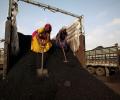
State-owned mining giant, Coal India, is hoping to recover around 75-80 per cent of its liabilities from customers with whom it has long-term fuel supply agreements (FSAs) after the Supreme Court (SC) allowed states to recover dues retrospectively. A legal recourse, however, is underway. "We are impacted in two states - Jharkhand and Odisha.

'One of the aspects for transparency and fair governance is to give the industry being represented the chance of lobbying with the regulator.'

'In the case of corporate credit, especially to AAA borrowers, lenders will have to take a fresh look at pricing.'
'The biggest impact will be on coal and hence on power cost. Then comes iron ore, coking coal, bauxite.'

Public sector banks (PSBs) posted 16.1 per cent year-on-year (Y-o-Y) growth in net profit at Rs 39,974 crore during the June 2024 quarter. While net interest income (NII) showed subdued growth of 7.1 per cent, provisions and contingencies declined by 10.5 per cent Y-o-Y. This aided the bottom line to show steady growth.

From setting up cutting-edge facilities to cater to the domestic market and building capabilities of global standards, the action is building up.

Private banks' net profit grew 26.3 per cent year-on-year (Y-o-Y) to Rs 48,982 crore in the first quarter ended June 2024 (Q1FY25) owing to healthy growth in credit and other income. The gross non-performing assets (GNPAs) increased with the end of dispensation granted during the pandemic, according to the data compiled by BS Research Bureau for listed 18 private banks.

In FY24, loans given out by such firms had topped a whopping Rs 146,517 crore, up by 49 per cent year-on-year and spread over 10.19 million accounts (up 35 per cent).

Chief executive officers (CEOs) across sectors have expressed intentions to expand capacities, expecting the government's target to invest a record Rs 11.11 trillion on infrastructure development will act as a catalyst for a jump in consumer demand. "With the government planning a capex of Rs 11.11 trillion, private sector investment will come in a big way. Companies will be preparing for it right from today," H M Bangur, chairman of Shree Cement, told Business Standard. For the past few years, the investment scene in India has been dominated by government capital expenditures; private investments in the manufacturing sector have remained muted.

'Bilateral trade has suffered seriously because of the growing unrest.' 'There is a standstill on both sides amid the curfew.'

There has been no change in Tata Steel's strategy on operations in the United Kingdom (UK), company chairman N Chandrasekaran has told shareholders. The statement comes amid growing concern about the restructuring plan in the face of change in government in the UK. Tata Steel's plan for the UK entailed a 1.25 billion investment plan agreed upon by the Conservative party-led government in September last year.

Bain Capital-backed Tyger Capital is planning to list its shares on the Indian stock exchanges by the next financial year and is targeting to grow its assets under management by four times to Rs 20,000 crore in five years from Rs 5,000 crore now, Gaurav Gupta, MD and CEO of the firm said. In an exclusive interview, Gupta said that keeping with the growing business, the finance company expects to on-board 600 people in the current financial year as it is opening 60-65 new branches for broad-basing its network in the country.

Despite steady loan growth, the banking sector is expected to report subdued margins in the quarter ending June 2024 (Q1FY25), driven by high demand for deposits amidst tight liquidity conditions. However, according to Bloomberg analysts, listed banks are forecasted to see a 14.5 per cent year-on-year (Y-o-Y) increase in net profit. Estimates showed that banks' net interest income (NII), and revenues from interest minus interest expenses might grow 11.9 per cent Y-o-Y.

Severe skilled, unskilled shortage threatens to pull emergency brakes on India's industrial engine.

India's leading steel companies hope the Modi 3.0 Budget will continue the massive capital expenditure currently underway, focusing on infrastructure development, manufacturing, and fair trade. The infrastructure segment is the largest steel user, and the government's focus has fuelled steel consumption even as international markets have underperformed. According to provisional statistics, steel consumption grew 13.6 per cent in FY24, reaching 136 million tonnes (mt), according to a CRISIL report.

It was the summer of 2006 (May 18). Writers' Building, then the state secretariat, was buzzing with journalists. The event marked the start of Buddhadeb Bhattacharjee's second term as chief minister. And in style, it got off with West Bengal bagging the small car plant, Nano.
 © 2025 Rediff.com - Investor Information - Advertise with us - Disclaimer - Privacy Policy - Sitemap - Feedback - About us - Terms of use - Grievances